

Building Lucifer: an open-source AI company you can watch · ⭐ GitHub
🚀 Start here: 1. Meet Lucifer · 2. Why I built it · 3. Architecture
📖 Use it: 4. Getting started · 5. Connect an LLM · 6. Office tour
🛠 Build the engine: 7. Org chart in YAML · 8. Real delegation · 9. Sandboxed tools · 10. Simulation brain
🎨 Build the office: 11. 3D office with R3F · 12. WebSocket + zustand · 13. Visualizing workflow
🧭 What's next: 14. Roadmap · 15. Contributing
Lucifer started as something to watch: angels on a yacht turning your goals into documents. The goal is a company you can actually run, one that takes a real client brief, ships a real product and markets it. This post walks through the road there. Every item is open to contributors, and the full list lives in ROADMAP.md.
Where we are today
- A multi-level org chart in YAML, with a model and effort per employee.
- Real delegation of any depth, with every subtask a first-class task.
- Seven sandboxed tools, with deliverables written as files.
- Claude natively, or any model behind Cloudflare AI Gateway, plus a free simulation brain.
- A 3D office with live missions, work links, a follow camera and break time.
What's missing is everything that makes a real team work well: asking questions, reviewing each other's work, and tools that produce more than text.
🤝 Agents that work together like a real team
Today, work only flows downward. Real teams negotiate.
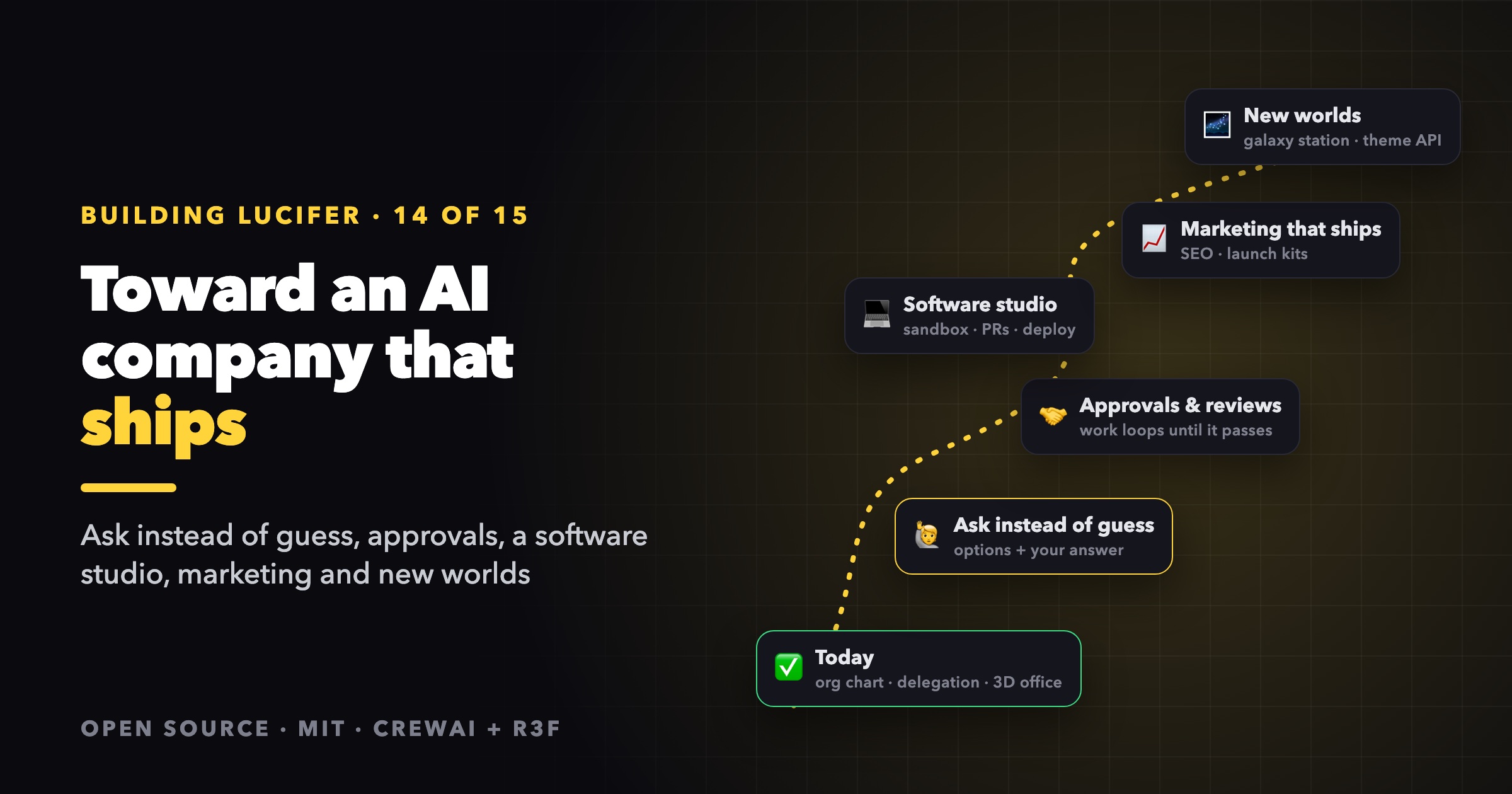
Ask instead of guess
This is the next big step. When an agent isn't confident about a vague brief, two equally good directions or a risky trade-off, it pauses and asks.
- The manager is asked first. If the manager isn't sure either, the question reaches you.
- The question shows up as a card in the office with a few concrete options, each with the agent's recommendation and its reasoning, plus a box to type your own answer.
- The task waits in a "needs input" state, and the angel raises a hand at its desk.
- Work resumes the moment you answer, and your answers are remembered, so the same question isn't asked twice.
It should fit the engine naturally: likely one more tool, one more task state and one more way for a task to be woken.
Approvals and review loops
- A manager reviews a report's deliverable and approves it or sends it back with comments.
- Risky actions, such as spending money, publishing or deploying, wait for your approval.
- QA reviews engineering output, the CMO reviews copy, and work goes around until it passes a quality bar.
Requests between colleagues
Any angel can ask a peer for help: "Lilith, I need a hero image for this page." The peer accepts, declines or negotiates a deadline. That's the first sideways arrow in an org chart that today only points down.
Meetings
Stand-ups and kickoffs where angels gather around a table on the deck, discuss a plan and leave with assignments. You'll be able to watch the meeting happen in 3D.
🎬 Real production work
Tools that turn the company into one that delivers real output, not just documents:
- Video production. Scripts, storyboards and voice-over, rendered with AI video models through a pluggable media-provider interface.
- Image and brand design. Logos, social visuals and product mockups from image models.
- Web research. Search and read the web, with sources cited in every deliverable.
- MCP tools. Connect the company to any MCP server, such as GitHub, Notion, Slack or Google Drive.
All of these arrive as tools behind the same TaskSession boundary described in Sandboxed agent tools.
💻 A software studio that ships
Turn a client's request into a running app:
- Client portal. Clients submit a brief, answer clarifying questions, watch progress and approve milestones.
- Code in a sandbox. Engineers write, run and test code in an isolated container instead of only writing files.
- Git workflow. Each feature is a branch and a pull request, reviewed by Michael (the CTO) before merge.
- One-click deploy to Cloudflare Pages, Vercel or Fly.io, with a live preview link delivered back to the client.
- Project templates: a landing page, a SaaS starter, a mobile app (Expo) and a Chrome extension.
📈 Marketing that brings users
Shipping is half the job. The marketing team makes sure people find what was built:
- SEO pipeline. Keyword research, technical SEO audits of the shipped site, and blog content clustered around target keywords.
- Launch kits. Product Hunt posts, social threads, newsletters and press releases, in every language the product supports.
- Scheduled publishing to social channels and blogs, always behind your approval.
- Analytics loop. Read traffic and conversion data, report what worked and suggest the next round of content.
🌌 New worlds to work in
The yacht is only the first office. Redemption is a journey, and the office should travel with it:
- Galaxy station. The company lifts off and works from a space station drifting through nebulae, with desks on floating platforms and angels flying between them in zero gravity.
- Heaven's gate. A marble office among the clouds, unlocked once the company has earned enough good deeds.
- More worlds: a mountain monastery, a neon city rooftop, an underwater dome.
- Theme API. A theme is a self-contained scene module (environment, desk layout, break-time spots), so anyone can add one without touching the core.
- Seasons and weather. Day and night cycles, rain and storms that follow the real clock.
✨ More ideas
- Redemption meter. Every task delivered honestly adds light. Halos grow brighter, angels level up and new worlds unlock. Failures reported openly count too, because owning a mistake is part of making amends.
- Budgets and a cost dashboard. A token and money budget per agent, department and project, with alerts before you overspend.
- Company memory. A shared knowledge base, so angels remember past projects, client preferences and lessons learned.
- Recurring work. "Every Monday, write the weekly report", run on a schedule.
- Hire and fire from the UI. Edit the org chart live and give each angel a model, tools and a personality.
- Company templates marketplace. Share ready-made org charts (agency, game studio, law firm, newsroom) as YAML.
How to get involved
Pick whatever excites you. Some items are a weekend, such as a new company template, a new language or a new beach prop. Others are a project, such as ask-instead-of-guess or the theme API. If you want to take something on, open an issue on GitHub so we can shape it together. Then follow How to contribute for your first pull request.
And if you'd just like to follow along, ⭐ star siri2moon/lucifer. It genuinely helps the project find the people who'll build it.
Lucifer is open source under the MIT license. Clone it, run it for free with the simulation brain, and ⭐ star it if you'd like to follow along: github.com/siri2moon/lucifer.
Next in the series: How to Contribute to Lucifer: Your First Pull Request.